|
|
Schaller Consulting |  |
|
| Home | Press | Publications | Taxi Research |
|
|
|
Taxis, Transportation Network Companies, and the Implications of New Technologies
On the other hand, if outmoded regulatory structures are kept in place, the result could be a race to the bottom in which the least responsible and least accountable operators win out, and services ruled by the maxim, "Buyer Beware." We could also end up with a regulatory system hamstrung by fragmentation between state and local governments, with little prospect of rationalizing inequitable and counterproductive differences in regulatory requirements between taxis, sedans and TNCs. That is the overview, now let's turn attention to what recent trends policy-makers should be paying the most attention to.
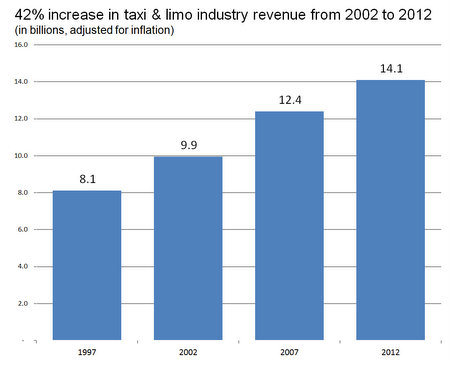
1. An Expanding Market for For-Hire ServicesEven before TNCs came on the scene, the taxi and limousine industries (which include traditional cabs, sedan services and luxury limousines) has been growing more rapidly than virtually any other part of the transportation system:
Source: U.S. Department of Commerce and U.S. Census Bureau, Economic Census, Transportation and Warehousing Statistics and Nonemployer Statistics;
Source: U.S Census Bureau, Decennial Census and American Community Survey
2. The business model of TNCs is solving long-standing barriers to expanding the pie for ride services, including availability and transparency.Up until TNC smartphone apps arrived, when you called a cab to come pick you up at your home, workplace, grocery store, hotel or wherever you might be, you often had no idea how long it would take for the cab to actually arrive. The dispatcher might tell you, "Five minutes, ma'am," but you likely knew from previous experience not to set your watch by this. This uncertainty greatly discouraged people from calling in the first place. The second and closely related problem was that large swaths of many cities around the country had long and unreliable wait times for telephone orders. This fact has been documented in a number of cities, from San Francisco to Boston. This even further discouraged people from using the service.The implications of long and unreliable wait times is profoundly important for cities. To leave their car at home, and even more so, to forego car ownership entirely, urban dwellers need to know that they have a menu of reliable transportation options that include public transportation and taxis, and now often include bike share and car share. Taxis are particularly important because sometimes people just need to quickly get from point A to point B, or they have packages or kids that make other options unattractive. But without quick and reliable taxi pick-ups, they have every incentive to take their car instead. The maps featured prominently on TNC smartphone apps show clearly where available vehicles are and an estimated time for the pick-up. When you request a trip you know with reasonable precision how long you will have to wait. And as you wait, you can see the driver coming toward you and how much longer you have to wait. A quick survey of these apps show that TNCs have vehicles readily available in areas ranging from the Sunset District of San Francisco to Dorchester in Boston or outer areas of the Maryland suburbs where it was once hard to get quick or reliable cab service. Reliability and transparent availability means that people are more likely to avail themselves of a wide range of transportation choices beyond the private motor vehicle. And it means a growing market for for-hire services.
3. Customers will drive the industry.There is a long and often colorful history to taxi regulation and local politics, dating back to Depression-era caps on the number of taxi licenses and even before that. In major cities, taxi regulation has been governed as much by politics as by customer needs. The TNCs are changing that. They have moved aggressively to stay outside of many of the regulatory constraints faced by taxi operators, most significantly, regulations on the number of vehicles. They can thus expand to meet customer demand and have sufficient vehicles available in those far-flung neighborhoods like the Sunset District and Dorchester as well as downtown and at the airport. That's why they are expanding rapidly, and why in some cities, customers are switching in droves from taxis to TNC services. The long-established taxi companies need to respond by offering competitive services. And regulators need to respond to adapt laws and regulation to the new terrain.
4. The current regulatory framework is archaic.The figure below schematically diagrams the current industry segments, customer markets and regulatory framework. As the figure makes clear, it's complicated and messy. Companies providing very similar services are subject to significantly different regulatory requirements, in some cases propelling their costs upward and constraining their ability to compete.
What is a rational regulatory structure? My paper titled Entry Controls in Taxi Regulation: Implications of US and Canadian experience for taxi regulation and deregulation , published in the peer-reviewed journal Transport Policy in 2007, looked at the previous great period of regulatory change, deregulation in the 1970s and 1980s. Deregulation -- chiefly applied to vehicle caps -- was seen as a failure in many cities. Instead of improving service quality and availability and driving down fares, it proved to spread existing demand across an oversupply of vehicles, with negative impacts on both the industry and public. Yet other cities deregulated and have been happy with the results. Why these differences? The explanation lies in the markets being served. Deregulation failed when applied to Flag services (e.g., taxi stand and hail trips) because drivers flooded into the market -- which was already adequately served -- leading to oversupply and an incentive for drivers to overcharge customers and shirk accountability for customer complaints. The telephone booking market (or Request market, which now includes the new app-based services) was not beset by oversupply. There, taxi companies providing dispatch services kept supply in line with demand. In addition, customers who were not satisfied with one company were in a position to choose a different company next time. Customer choice helped keep companies accountable and service quality acceptable.
Where to go from here?A modernized regulatory framework should be built around the key market distinction between Flag and Request services. Flag services need regulation to prevent oversupply; they also need fare regulation and certified taximeters so passengers can depend on being fairly charged. Request services do not. Request services need public safety regulation such as auto liability insurance requirements and driver background checks -- and they should be comparable to requirements for Flag services, to keep customers equally protected and maintain a level playing field.In addition, both Flag and Request services need a unitary regulatory system. That could be at the city or county level or could be regional in nature. The best approach probably varies by metropolitan area. But the current fragmented system that is developing in some states risks creating inconsistent and uncoordinated regulatory and enforcement regimes, and thus hampering the growth of responsive and responsible service providers.
There will be a number of issues to work out in the new world of taxis and TNCs. How should vehicles that serve both Flag and Request trips operate? Should meters be used for both types of trips? Should fares for request trips be regulated? In most places, these are novel issues that will need to be discussed, although they have been worked out successfully in a few locales, most notably with the new "green cabs" in New York City. Some issues are of long standing and will need to be addressed under any regulatory framework. How can wheelchair users be assured the same quality and availability of service as other customers? How can policy-makers ensure that outlying and often underserved areas receive equitable treatment? Other issues are still beyond the horizon but may be upon us soon. For example, how do the advent of potential new services such as true ridesharing and package delivery affect the regulatory structure? The answers to these questions will differ at least somewhat from city to city. But the potential for high-quality for-hire services that are responsive to customer needs and further the larger goals of economically and socially attractive and healthy cities is great. The task ahead is to turn the potential into reality.
This presentation was made by Bruce Schaller at the Workshop on The Evolution of On-Demand Transport, held on Sunday, January 11, 2015 at the Transportation Research Board's Annual Meeting. Bruce Schaller is a nationally known transportation policy expert based in New York City. He served until May 2015 as Deputy Commissioner for Traffic and Planning at the New York City Department of Transportation, and recently returned to his consulting practice as Principal of Schaller Consulting. He currently serves on the TRB Committee for the Study of Innovative Urban Mobility Services. The views expressed in this presentation are his own.
..
| ||||||